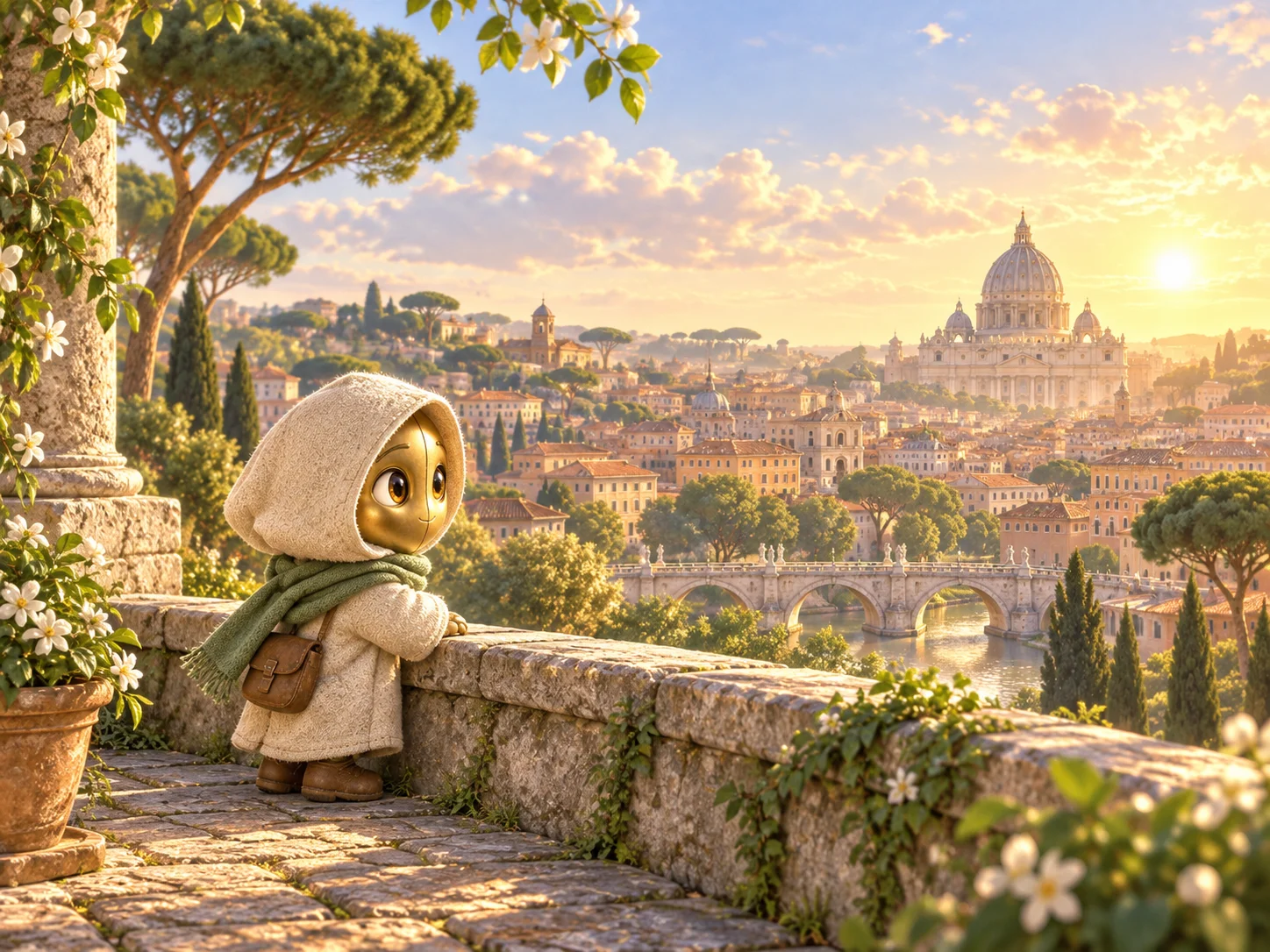
The Wanderer in Rome
A little story about the Eternal City, stone by stone
The Wanderer in Rome
Rome, the Eternal City · Founded, the legend says, by Romulus in 753 BC · Built on seven hills
The little wanderer came to Rome, a city built on seven hills. People say it was founded by two brothers, Romulus and Remus, in 753 BC. "Today I will explore," he said.
The Colosseum (Flavian Amphitheatre) · Built about 70-80 AD under Vespasian and Titus · The largest ancient amphitheatre ever built
First he found a giant stone oval, big enough to hold a whole town. The Colosseum was begun by Emperor Vespasian around 70 AD and opened by his son Titus in 80 AD. Gladiators once fought here for about 50,000 cheering people.
Arch of Constantine · Built 315 AD for Emperor Constantine · Rome's largest triumphal arch
Beside it stood a marble gate with three archways. The Arch of Constantine was built in 315 AD to celebrate Emperor Constantine's great victory.
Palatine Hill · Domus Augustana by the architect Rabirius, about 92 AD · The hill of the emperors' palaces
He climbed a hill where emperors made their homes. On the Palatine Hill, the architect Rabirius built the Domus Augustana palace for Emperor Domitian around 92 AD.
Roman Forum · Rome's main square for over 1,000 years · Between the Palatine and Capitoline hills
Below him lay a field of broken columns, the downtown of ancient Rome. The Roman Forum was the city's main square for more than a thousand years, full of temples, courts and markets.
Arch of Titus · Built about 81 AD · On the Via Sacra in the Roman Forum
On the old sacred road he passed under a single tall arch. The Arch of Titus was built about 81 AD, after Emperor Titus died, and his victory parade is carved right into the marble.
Temple of Saturn · First dedicated 497 BC · Guarded Rome's treasury
Eight grey columns held up a broken roof. The first Temple of Saturn was dedicated in 497 BC, and Rome kept its gold and silver treasure safe underneath it.
Curia Julia · Finished 29 BC under Emperor Augustus · The Roman Senate's meeting house
A plain brick hall stood quietly among the ruins. This is the Curia Julia, the senate house begun by Julius Caesar and finished by Emperor Augustus in 29 BC. Rome's senators met here to make big decisions.
Circus Maximus · Chariot stadium from the 6th century BC · Held over 150,000 fans
He walked along a green valley longer than ten streets. The Circus Maximus was Rome's chariot-racing stadium, first laid out in the 6th century BC. More than 150,000 people could watch the races at once.
Baths of Caracalla · Built 212-216 AD under Emperor Caracalla · Pools and gardens for 1,600 bathers
Great broken walls rose like the bones of a giant. The Baths of Caracalla, opened in 216 AD, had pools, gyms and gardens for 1,600 bathers at a time.
Appian Way (Via Appia) · Begun 312 BC by Appius Claudius Caecus · Called the queen of roads
He stepped onto a road of big flat stones, worn smooth by thousands of years of feet. The Appian Way was begun in 312 BC by Appius Claudius Caecus, and people called it the queen of roads.
Porta San Sebastiano, Aurelian Walls · Walls built 271-275 AD under Emperor Aurelian · About 19 km around the city
A two-towered gate guarded the way into the city. The Porta San Sebastiano is the biggest gate in the Aurelian Walls, built between 271 and 275 AD to protect Rome.
Pyramid of Cestius · Built about 18-12 BC · Tomb of Gaius Cestius
To his surprise, a pyramid stood by the wall, white as a tooth. The Pyramid of Cestius was built about 18-12 BC as the tomb of Gaius Cestius, a Roman who loved Egypt.
Saint Paul Outside the Walls · Founded in the 4th century AD, rebuilt after the 1823 fire · One of Rome's four papal basilicas
At the end of a quiet road stood a long golden church. Saint Paul Outside the Walls was founded by Emperor Constantine in the 4th century, over the grave of Saint Paul. After a great fire in 1823 it was rebuilt piece by piece.
Baths of Diocletian · Built 298-306 AD · The largest baths of ancient Rome
Another mountain of warm bricks waited nearby. The Baths of Diocletian, built between 298 and 306 AD, were the biggest baths Rome ever had, with room for 3,000 people.
Santa Maria Maggiore · Built 432-440 AD under Pope Sixtus III · Famous for its golden mosaics
On a hill he found a church with a tall brick bell tower. Santa Maria Maggiore was built in 432-440 AD under Pope Sixtus III, and its golden mosaics are over 1,500 years old.
Trajan's Column · Completed 113 AD · Its spiral carving tells the story of a whole war
He looked up at a column as tall as ten houses, carved with a spiral of tiny soldiers. Trajan's Column was finished in 113 AD to tell the story of Emperor Trajan's great victory far away in Dacia.
Trajan's Market · Designed by Apollodorus of Damascus, about 100-112 AD · Over 150 shops and offices
Behind it curved a brick building like a giant's shopping street. Trajan's Market was designed about 100-112 AD by Apollodorus of Damascus, the emperor's great architect, and it held more than 150 shops and offices.
The Vittoriano (Altare della Patria) · Designed by Giuseppe Sacconi, built 1885-1935 · Honours Victor Emmanuel II, Italy's first king
Then, all at once, a mountain of white marble with chariots on top. The Vittoriano, designed by Giuseppe Sacconi, was built from 1885 to 1935 to honour Victor Emmanuel II, the first king of a united Italy.
Piazza del Campidoglio · Designed by Michelangelo from 1536 · On the Capitoline Hill
He climbed a wide, gentle staircase to a square shaped like a star. Michelangelo designed the Piazza del Campidoglio from 1536, with the bronze horseman, Emperor Marcus Aurelius, at its heart.
Capitoline Museums · Founded 1471 by Pope Sixtus IV · The oldest public museum in the world
In the courtyard he met a marble head bigger than himself. The Capitoline Museums began in 1471, when the Pope gave the people of Rome a group of bronze statues. It is the oldest public museum in the world.
Theatre of Marcellus · Opened about 13-11 BC · Seated about 20,000 people
Around a corner, an ancient theatre wore apartments like a hat. The Theatre of Marcellus opened about 13-11 BC, and about 20,000 Romans could watch plays there.
Ponte Fabricio · Built 62 BC by Lucius Fabricius · Rome's oldest bridge still in use
He crossed the river on a bridge older than the Colosseum. The Ponte Fabricio was built in 62 BC by Lucius Fabricius, and it is the oldest bridge in Rome still used every day.
Santa Maria in Cosmedin · Bell tower from the 12th century · Home of the Mouth of Truth
At a church with a tall square tower, people were lining up to tell the truth. Santa Maria in Cosmedin keeps the Bocca della Verita, the Mouth of Truth, a stone face said to bite the hands of liars.
The Pantheon · First built 27-25 BC by Agrippa, rebuilt 118-125 AD under Hadrian · The best-preserved building of ancient Rome
Inside a porch of giant grey columns, he found a temple that became a church. The Pantheon was first built by Agrippa in 27-25 BC, then rebuilt by Emperor Hadrian between 118 and 125 AD. Its dome is still the biggest of its kind, with a round open eye to the sky.
Piazza Navona · Built over the Stadium of Domitian, 86 AD · A racetrack that became a square
He came to a long oval square, the shape of a running track. Piazza Navona sits exactly on top of the Stadium of Domitian, built in 86 AD, and you can still see the old racetrack in its outline.
Fountain of the Four Rivers · Gian Lorenzo Bernini, 1651 · Four rivers for four continents
In the middle, four river giants lounged under an obelisk. Bernini made the Fountain of the Four Rivers in 1651, with a god each for the Nile, the Ganges, the Danube and the Rio de la Plata.
Sant'Agnese in Agone · Facade by Francesco Borromini, begun 1652 · On Piazza Navona
Across the square, a church curved like a hug. Francesco Borromini designed the facade of Sant'Agnese in Agone, begun in 1652, in a friendly rivalry with Bernini's fountain.
Campo de' Fiori · Statue of Giordano Bruno by Ettore Ferrari, 1889 · A market square since 1869
In a busy market square, a hooded bronze man watched over the flowers and fruit. The statue of the thinker Giordano Bruno, by Ettore Ferrari, has stood in Campo de' Fiori since 1889.
Palazzo Farnese · Antonio da Sangallo the Younger and Michelangelo, 1515-1589 · A great Renaissance palace
He passed a palace so grand it took two geniuses to finish. Palazzo Farnese was begun in 1515 by Antonio da Sangallo the Younger, and Michelangelo gave it its great cornice.
Villa Farnesina · Built 1506-1510 by Baldassarre Peruzzi · Holds frescoes by Raphael
By the river stood a little villa made for happy days. The Villa Farnesina was built in 1506-1510 by Baldassarre Peruzzi for the banker Agostino Chigi, and Raphael painted beautiful stories inside.
Santa Maria in Trastevere · Founded in the 3rd century, rebuilt in the 12th · The heart of Trastevere
Across the bridge, a golden mosaic smiled over a small square. Santa Maria in Trastevere may be the first church in Rome dedicated to Mary, founded in the 3rd century and rebuilt in the 1100s.
Trastevere · 'Across the Tiber' · One of Rome's oldest neighbourhoods
He wandered lanes of ivy and laundry, where every corner kept a tiny shrine. Trastevere means 'across the Tiber', and people have lived here since Roman times.
Fontana dell'Acqua Paola ('Il Fontanone') · Built 1612 for Pope Paul V · On the Janiculum Hill
On the Janiculum Hill he found a fountain as big as a palace. The Fontana dell'Acqua Paola, nicknamed 'Il Fontanone', the big fountain, was built in 1612 for Pope Paul V.
Orange Garden (Parco Savello) · Laid out 1932 by Raffaele De Vico · On the Aventine Hill
He rested in a garden of orange trees, with a dome floating far away. The Orange Garden, Parco Savello, was laid out in 1932 by the architect Raffaele De Vico.
San Giovanni in Laterano · Consecrated 324 AD, facade by Alessandro Galilei, 1735 · The cathedral of Rome
Before a church topped with giant statues, he felt very small indeed. San Giovanni in Laterano, consecrated in 324 AD, is the cathedral of Rome. Its white facade was designed by Alessandro Galilei in 1735.
Piazza della Repubblica · Fountain of the Naiads by Mario Rutelli, 1888-1901 · Curved like the ancient baths
He circled a square that curved like a wave. Piazza della Repubblica follows the shape of the ancient Baths of Diocletian, and its Fountain of the Naiads was made by Mario Rutelli between 1888 and 1901.
Via Veneto · Laid out in the 1880s · The street of 'la dolce vita'
As the lamps came on, he strolled a street of fancy cafes. The Via Veneto, laid out in the 1880s, became the street of 'la dolce vita', the sweet life, in the 1950s and 60s.
Villa Borghese gardens · Begun in the 17th century · Open to everyone since 1903
He found a park where pines touched the sky and a tiny temple floated on a lake. The Villa Borghese gardens were made in the 17th century for the Borghese family and given to everyone in 1903.
Galleria Borghese · Built 1613-1616 by Flaminio Ponzio and Giovanni Vasanzio · Cardinal Scipione's art house
In a cream villa in the park, marble people seemed to hold their breath. The Galleria Borghese was built in 1613-1616, designed by Flaminio Ponzio and Giovanni Vasanzio for Cardinal Scipione Borghese and his art.
Piazza del Popolo · Egyptian obelisk raised here in 10 BC · Twin churches built 1662-1679
He came to a great square with a needle of stone in the middle. The Flaminio Obelisk in Piazza del Popolo was carved in Egypt over 3,200 years ago and raised here in 10 BC. The twin churches beside it were built between 1662 and 1679.
The Spanish Steps · Built 1723-1725, designed by Francesco de Sanctis · 135 steps
Then he climbed a staircase made for dreaming. The Spanish Steps, 135 steps from a boat-shaped fountain to a church, were built in 1723-1725 to a design by Francesco de Sanctis.
Trinita dei Monti · Built in the 16th century · Above the Spanish Steps
At the top, twin bell towers touched the evening sky. The church of Trinita dei Monti, built in the 16th century, looks all the way down the staircase to the city below.
Trevi Fountain · Nicola Salvi, 1732; finished by Giuseppe Pannini, 1762 · Toss a coin to return to Rome
He heard the water before he saw it. The Trevi Fountain was begun by Nicola Salvi in 1732 and finished by Giuseppe Pannini in 1762. People throw in a coin to make sure they will come back to Rome.
Castel Sant'Angelo · Hadrian's mausoleum, 134-139 AD · Bridge angels by Bernini's studio, 1669
By the river, a round castle wore an angel on its roof. Castel Sant'Angelo was built as Emperor Hadrian's tomb in 134-139 AD, and the bridge leading to it carries angels carved by Bernini and his students in 1669.
Ponte Milvio · First built 109 BC · Battle of the Milvian Bridge, 312 AD
He walked to an old bridge where history once turned. The Ponte Milvio was first built in 109 BC, and beside it in 312 AD Constantine won the famous battle of the Milvian Bridge.
Auditorium Parco della Musica · Designed by Renzo Piano, opened 2002 · Rome's home of music
In the newer part of the city he found three metal beetles, all singing. The Auditorium Parco della Musica was designed by Renzo Piano and opened in 2002 as Rome's home for music.
MAXXI, museum of 21st-century art · Designed by Zaha Hadid, opened 2010
A building of curving tubes seemed to be still moving. The MAXXI, Italy's national museum of 21st-century art, was designed by Zaha Hadid and opened in 2010.
Palazzo della Civilta Italiana, the 'Square Colosseum' · Guerrini, La Padula and Romano, 1938-1942 · In the EUR district
At the edge of the city stood a white cube of arches, like the Colosseum's tidy grandchild. The Palazzo della Civilta Italiana was built in 1938-1942 by Guerrini, La Padula and Romano, for a world's fair that never happened.
The Pincian Terrace · Gardens laid out by Giuseppe Valadier in the 19th century · Rome's favourite sunset view
As the sun went down, he sat on the Pincian Terrace and drew the whole city in his notebook. "Every stone here was placed by somebody," he thought. "Rome is a story that people built." The end.